

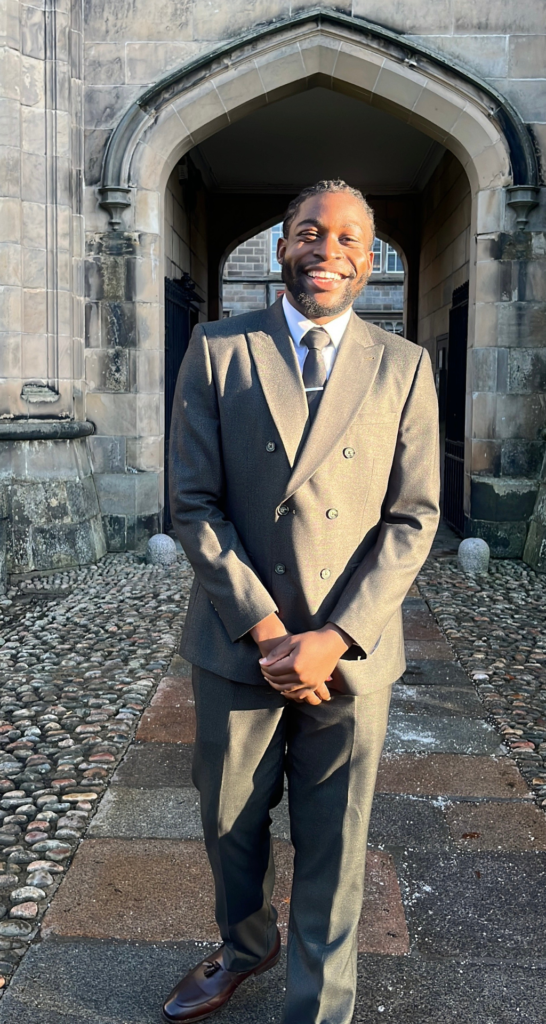
He Thought He Came to Aberdeen to Study Engineering.
Looking Back, That Was Only Part of the Story.
Some people spend years trying to discover who they are while others seem to reveal themselves simply by the way they live but for Oluwatimileyin Kalejaiye, perhaps the first clue was there from the very beginning. His name means "God is behind me. God is my support," and although he rarely draws attention to it, that belief quietly runs through every chapter of his life. It is there in the risks he has taken, the setbacks he openly speaks about, and the optimism with which he continues to build, even when the path ahead is uncertain.
Born in Southeast London and shaped equally by time spent in Surulere, Lagos, Oluwatimileyin grew up between two places that are often misunderstood. While outsiders might focus on the headlines, he remembers the community, the neighbours who looked out for one another, and people working hard to create better lives for themselves and their families. Watching ordinary people persevere left a lasting impression on him and planted a belief that progress is rarely instant. More often than not, it is built quietly through consistency, resilience and the willingness to keep going.
That mindset naturally led him towards engineering. Maths, Physics and Design and Technology were the subjects he enjoyed most at school, making the decision to study engineering an obvious one. In 2020, he chose the University of Aberdeen, not simply because of its reputation in engineering, but because he wanted something different from the pace of London. Aberdeen offered the chance to study close to industry while living in a smaller, calmer city where he could focus on learning and growing. Once there, however, he made a decision that reflected the way he approaches life. Rather than remain solely in Renewable Energy Engineering, he switched to Civil and Environmental Engineering, believing it would give him broader opportunities without losing sight of the impact he wanted to make. Even the electives he chose, Sustainability, Economics and Accounting, reveal someone who has always been interested in understanding how systems work, whether environmental, social or financial.
University, however, was never just about lectures and coursework. Long before entrepreneurship became fashionable, Oluwatimileyin was already experimenting. From selling hats as a young boy to running a clothing brand and later a service business while studying, he has always been drawn to the challenge of building something from nothing. Not every venture lasted, and he is refreshingly honest about that. Rather than presenting each attempt as a success, he speaks openly about the lessons they taught him, lessons that continue to shape the way he thinks today. It is a reminder that entrepreneurship is rarely a straight line and that some of its greatest rewards come long before financial success.
Ironically, the experience that would shape his future did not come from one of his businesses at all. It came from struggling. During his final year of engineering, despite having worked and saved throughout university, he found himself under real financial pressure. It would have been easy to accept it as part of student life and move on, but instead he became curious. Why did it happen? Why did so many young people reach adulthood without understanding personal finance? Why were practical financial skills something most people only learned after making expensive mistakes? Those questions stayed with him long after graduation and gradually transformed into something much bigger than his own experience.
Today, that season of uncertainty has become the foundation of a new mission. Through the financial content he creates and the development of PH7 Tools, a platform designed to help people better understand and manage their personal finances, Oluwatimileyin hopes to equip young people with knowledge he wishes he had much earlier. His work is not driven by theory alone. It comes from lived experience, from someone who understands both the anxiety that financial uncertainty creates and the confidence that knowledge can bring. In many ways, he is building the resources his younger self would have needed.
Yet there is another thread that runs consistently through his story, community. During his time at the University of Aberdeen, he and a dedicated team brought the African and Caribbean Society back to life after it had become inactive. Their goal was not simply to organise events but to rebuild a space where students could find belonging, friendship and support. The society continues to grow today, a testament not only to the work of those who followed, but also to the foundations that were laid when a group of students decided that their community deserved to exist. It is perhaps no coincidence that someone who grew up valuing community would later become someone who helps rebuild it.
Five years after arriving in Aberdeen, the city he expected to be a temporary stop has become home. Having completed both his undergraduate degree in Civil and Environmental Engineering and a Master's in Sustainability Transitions, he has accepted a graduate role that will see him remain in the city. For someone who originally came seeking an education, Aberdeen has given him much more than a qualification. It has given him opportunities, friendships, purpose and a community that he now hopes to contribute to for many years to come.
Spend a few minutes reading Oluwatimileyin's reflections online and one thing quickly becomes clear. He has little interest in presenting a polished version of himself. He celebrates his wins with gratitude, speaks honestly about the moments that tested him, and never pretends to have all the answers. In a world where success is often carefully curated, there is something refreshing about someone who is still willing to admit he is learning.
Perhaps that is what makes his story resonate. It is not the story of someone who had every step mapped out or someone whose journey has been free from uncertainty. It is the story of a young man who continues to say yes to learning, yes to building, and yes to serving others, trusting that each experience, whether success or setback, is preparing him for whatever comes next. Sometimes the most inspiring stories are not about people who have reached the finish line. They are about those who keep moving forward with quiet conviction, believing that every chapter has something to teach them. Oluwatimileyin Kalejaiye is still writing his story, and somehow, that makes it even more compelling.