

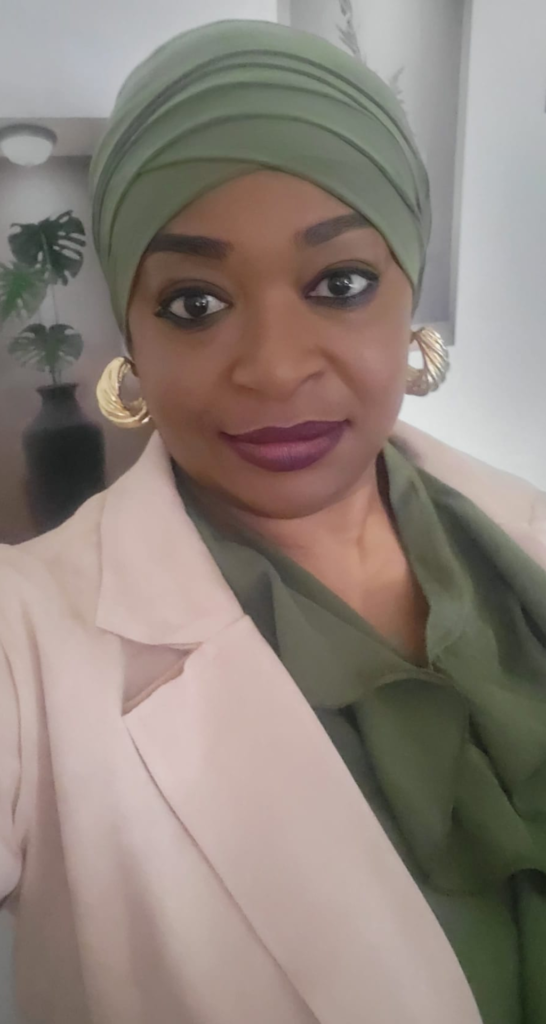
She built belonging instead of waiting for it to be handed to her.
Ramatu Umar Bako carries two homes in her heart, one shaped by Nigeria, where education for girls is still contested ground,and the other shaped by Scotland, where she has spent years asking harder questions about power, participation, and who gets to decide. Ramatu’s story is steady and it is strong.
She began with law, a discipline that teaches you how systems work, and sometimes how they fail. Yet Ramatu was not only interested in rules. She wanted to understand the forces underneath them. Conflict. Identity. Inequality. Voice.
That curiosity led her to complete a Master’s in Global Conflict and Peace Processes at the University of Aberdeen, and later a Master’s in Adult Education, Community Development and Youth Work at the University of Glasgow, where her research centred on participation, power, and social justice For Ramatu, education equals dignity. In a world where education for girls is still being challenged, she carries education like a responsibility.
Her work is rooted in race, gender, disability, health inequality, and community voice and it is why she brings both academic rigour and lived experience into every space she enters.
Over the past fifteen years, she has worked across public institutions, grassroots organisations, academia, and the third sector, shaping conversations around health equity, anti racism, disability rights, and climate justice.
Her strength is in the way she gives analyses and the way she connects, Ramatu builds partnerships that hold complexity without collapsing under it. She creates spaces where underrepresented voices are not treated as case studies, but as expertise. She listens in rooms where others dominate and she speaks when silence would be easier.
As a Black woman in Scotland, Ramatu’s work is personal.
Belonging is not abstract when you have felt its absence and inclusion is not theoretical when you have experienced exclusion.
Through research, policy influence, and community organising, she remains rooted in a belief that communities already hold the answers. Providing access to power, participation in decision-making and collaboration across sectors will create partnerships that meet the needs and aspirations of all.
Ramatu’s story is not about visibility for its own sake. Her story is about transformation built through relationships, courage, and hope. A Nigerian heart, a Scottish home, and a global citizen shaping spaces where more of us can belong.
Ramatu’s work continues and so does the change she is helping to build.